


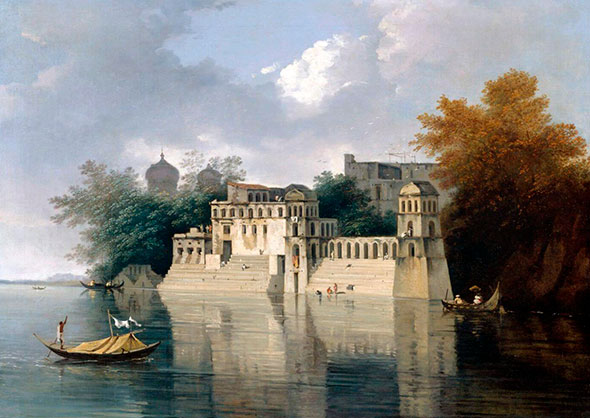
William Hodges (1744-1797) was an English painter. He was a member of James Cook's. He traveled to the Pacific Ocean, and is known for drawings and paintings of the places he visited on that trip, including Table Bay, Tahiti, Easter Island, New Zealand, and Antarctica.
Hodges was born in London. He studied with William Shipley, and later at Richard Wilson's studio, where he met Thomas Jones.
Between 1772 and 1775, Hodges accompanied James Cook to the Pacific as an artist on the expedition.
Many of his sketches and water paintings of him were adapted as prints in the original published edition of Cook's journals of the trip. These paintings represented stronger light and shadow than was customary in the European landscape tradition.
Contemporary art critics complained that his use of light and color contrasts gave his paintings a rough and unfinished appearance. Easter Island Man, 1776 (British Museum) Hodges also produced many valuable sketches of portraits of Pacific Islanders and scenes from the voyage involving members of the expedition. In 1778, under the patronage of Warren Hastings, Hodges traveled to India, one of the first British professional landscapers to visit that country. He stayed there for six years. In 1793 he published an illustrated book on his travels in India. He subsequently traveled through Europe, including a visit to St. Petersburg in Russia.
In December 1794, Hodges opened an exhibition of twenty-five of his own works at Orme's Gallery, 14 Old Bond Street, London, which included two large paintings entitled The Effects of Peace and The Effects of War. At the end of January 1795, with Great Britain involved in the War of the First Coalition against Revolutionary France and sentiments on high, the exhibition was visited by Prince Frederick, Duke of York and Albany, the second son of King George III. . The duke was offended by the political nature of the paintings and ordered the exhibition closed; this royal censorship effectively ended his career as a painter. Many of his works were later sold at auction, but they produced only a negligible sum.


0 comments